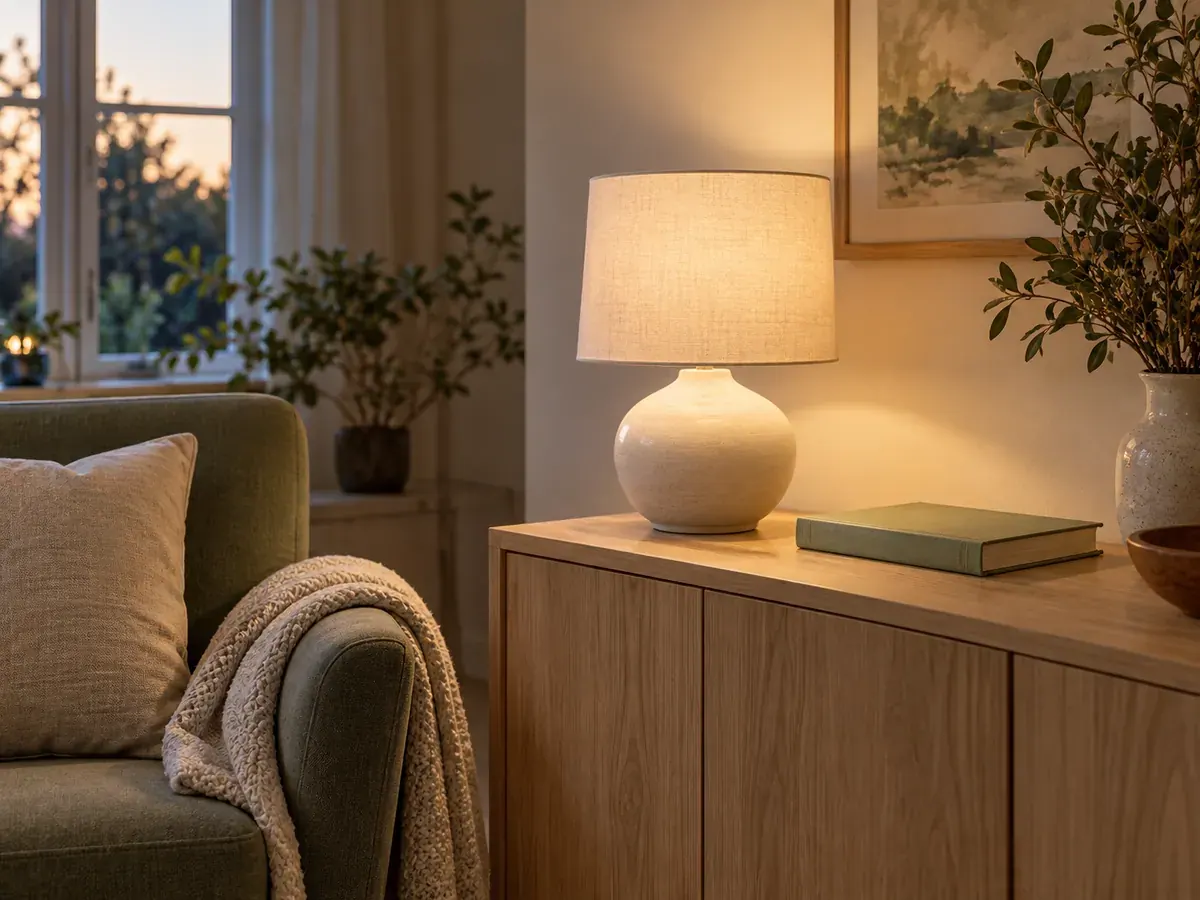
Start with three everyday tasks
Stand in the room and imagine entering it, changing clothing, and sitting down with your baby. Each task may need a different amount or direction of light. A decorative glow can be pleasant but insufficient for reading a label or finding a dropped item. A bright ceiling light may cover the room while feeling unnecessarily strong when you only need to find your way to a chair.
You do not necessarily need three products. An existing ceiling fixture with suitable controls and one well-placed task light might cover the jobs. Start with what you have, identify the actual gap, and buy for that gap.
Draw a simple room plan showing doors, outlets, furniture and the baby's sleep space. The most attractive lamp is not the right choice if it only works in a location you cannot use safely or conveniently.
Read brightness and colour as separate specifications
The FTC's Lighting Facts guidance distinguishes lumens, which describe brightness, from watts, which describe energy use. It also explains light appearance using colour temperature in kelvin. These tell you different things; a warm-looking bulb is not necessarily a dim bulb.
Compare the available specifications for your actual product. For a replaceable-bulb lamp, check the required bulb base, permitted wattage and any restrictions in the fixture instructions. For an integrated light, ask what brightness adjustment is available and what happens if the light source eventually fails.
Choose colour appearance according to the room and your preference. A warm appearance may suit the atmosphere you want, while a different light may help with a particular task. This guide does not rank colours as treatments for sleep or make claims that a nursery lamp will change a baby's health.
Check the lowest useful setting
The maximum brightness is only part of the decision. If you want gentle illumination, find out how the light behaves at its lowest setting. Can you see what you need without turning on every light? Does adjustment require several taps, an app or holding a button for a precise amount of time?
If possible, see the product in a dim room or ask for a demonstration. A promotional photograph is difficult to interpret because the photographer can change exposure. The brightness of the image is not a measurement of the lamp.
Check compatibility between any dimmer, fixture and bulb using the manufacturers' instructions. Do not assume that buying a bulb labelled dimmable makes every existing switch suitable. If changes involve electrical installation, use appropriate local professional help.
Controls should make sense when you are tired
Imagine operating the light with one hand, without looking closely. A clear physical switch may be more useful to you than a long list of app features. Alternatively, you may want a remote or automation because the light is deliberately placed away from the chair. Either approach can work if it matches the room.
Ask these questions before buying:
- Can an unfamiliar caregiver operate the basic light without instructions?
- Does it remember the last setting, and do you want it to?
- What happens after a power interruption?
- Can you still turn it on if a phone, app or network is unavailable?
- Are there indicator lights or sounds that you would find distracting?
- Are replacement controls or necessary accessories included?
Treat unanswered questions as things to verify with the manufacturer. Do not fill in missing product details from a similar-looking model.
Plan the location before choosing the style
The CPSC's electrical-cord warning says to keep cords and monitor components beyond children's reach, at least three feet away. Plan lamp and charging-cord routes with that hazard in mind, and follow the product's placement instructions.
Look beyond the light itself. Where will its adapter sit? Does the cable create a loop or cross a walking route? Can the furniture be pulled or climbed on as your child grows? A location that seems convenient today deserves another check when the room changes.
Do not drape fabric over a lamp to soften the light, modify its shade, or use it as a heater. Buy a product that provides the light you need in the intended configuration. Keep ventilation and clearance requirements visible in your setup notes.
Compare the types without assuming one winner
This is a comparison of possible uses, not a recommendation for an unnamed model. Read the instructions for the exact item, including battery access, approved charging equipment and cleaning where applicable.
Test the room, not just the lamp
Once installed according to its instructions, walk through your normal care routine without the baby first. Check that supplies are visible, the switch is accessible and your body does not block the light where you need it. Sit in the chair and look toward the fixture to judge whether the exposed light is uncomfortable.
Try the room at the times you expect to use it. Daylight can hide an awkward evening shadow. A corner that looks dim in the afternoon may be adequate after dark, or the reverse may be true depending on the task.
Make small adjustments to the intended placement or brightness before buying another product. If the room still does not work, identify the missing function precisely. “I cannot read the care label beside the changing supplies” is a more useful shopping brief than “the nursery needs better lighting.”
Nursery light and photo light are different decisions
Buy everyday lighting for everyday care. For baby photographs, begin by checking the natural light already available in the home. You may find a different room makes a simpler picture than the nursery.
Our window-light guide for newborn photos explains how to think about that setup. If colours look inconsistent, first compare a test photograph under one light source with a photograph under mixed room lighting; use the result to choose the simpler scene. You do not need to build a studio around the changing area.
For a broader purchase review, use the baby product online-shopping checklist before ordering a fixture from an unfamiliar seller.
Frequently asked questions
Is a nursery-specific lamp necessary?
No. A suitable general household light may do the job if its specifications, placement and instructions fit your room. “Nursery” in a product name does not answer those questions.
What brightness should I buy?
There is no single useful number for every room and task. Check the available range, direction of light, room layout and lowest usable setting. Keep enough illumination for the care task you are doing.
Should I choose a smart light or a simple switch?
Choose the control you and other caregivers can use reliably. Smart features may be convenient, but understand their setup and fallback operation before relying on them.
Does a warm-coloured light guarantee better baby sleep?
This buying guide does not establish that claim. Treat colour as a feature to assess alongside brightness and usability, and discuss individual sleep concerns with your baby's healthcare professional.
Keep photo planning simple
Browse Baby Lovin's portrait inspiration and use light that already suits a safe, comfortable photo setup. The nursery can remain a room designed around everyday family life.
Sources