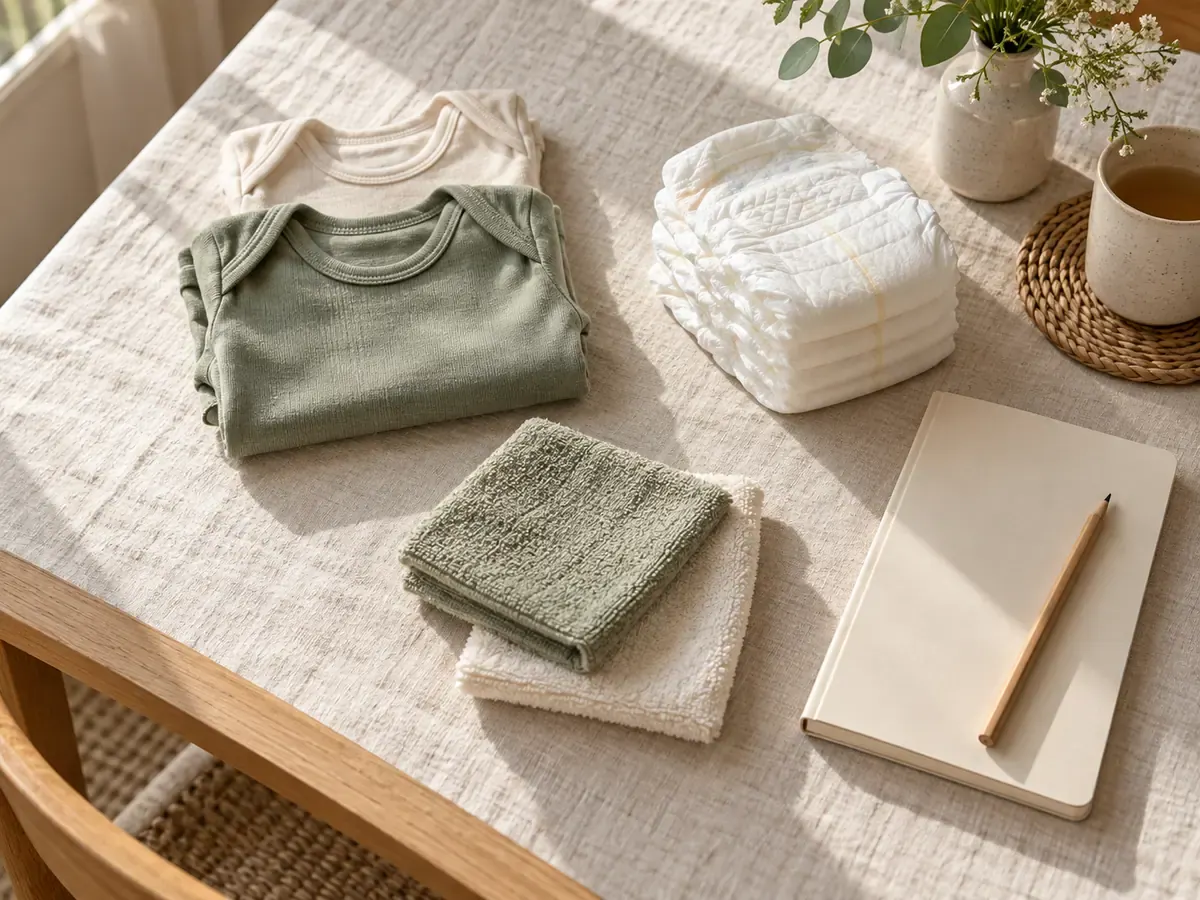
Start with your home, not a product catalogue
Before adding an item, picture where you will use it, where it will live, and who will clean it. A useful product should have a clear answer to all three. A large set of matching accessories can be less helpful than one small item that solves a daily problem in your particular home.
Write down five facts: your available storage, access to laundry, usual transport, likely helpers, and how easily you can buy something later. A family with shared laundry and limited delivery access may sensibly keep more spare clothing than a family with a washing machine and nearby shops. Minimalism is a fit between possessions and daily life, not a competition to own the fewest things.
For feeding and individual care needs, build around your own care team's guidance and your preferences. You do not need to resolve every future decision while making a gift list.
A starter checklist organised by job
Use this as a planning framework. It is not a required shopping list or a medically prescribed quantity.
Keep the sleep purchase focused. In the United States, the CPSC's safe-sleep guidance recommends a sleep product that meets applicable requirements, placing baby on their back, and keeping the space clear apart from its fitted sheet. It advises against pillows, loose blankets and weighted infant sleep products. Decorative additions do not belong on the sleep essentials list.
Sort the registry into three decisions
Needed for the first routines
These are items you can already connect to a repeated task. Try describing that task in one sentence: “We need somewhere to keep clean changing supplies beside the place we change the baby.” That sentence may lead to a basket you own, rather than a specialist storage system.
For any large purchase, measure the space and access route before choosing the model. Record the dimensions in the registry note so a well-meaning gift giver understands why you picked that particular version. A similar-looking substitution might have very different dimensions.
Useful after you learn your preferences
Some purchases depend on information you do not yet have. Place these on a private later list. Examples might include extra duplicates, a more elaborate storage arrangement, or additional memory-making supplies. Waiting is a positive decision when the consequence of waiting is simply buying the item later.
A gift card can preserve flexibility if it is for a shop you can use, in the correct country and currency, with terms you understand. Check those details before putting it on the registry.
Lovely if there is room
A personal gift does not have to defend itself as essential. An album, a family photo print or a special everyday outfit may matter to you. Give these items a modest, deliberate place in the list instead of adding dozens of products because they belong to a theme.
Our keepsake gift guide helps distinguish a meaningful memory gift from a project the parents may never want to complete.
Choose quantities with a laundry experiment
Instead of copying someone else's exact clothing count, write a pretend week. Mark when washing can happen, how long drying takes, and when you can put clean items away. Then consider how much backup would let you handle a missed wash without stress.
For example, a household that washes every other day might prepare a small accessible drawer and a separate reserve. A household that uses a shared laundry once a week needs a different plan. These are planning examples, not predictions about how often a particular baby will need changing.
Use the same logic for cloths and other washable items. Count what you already have before buying a coordinated set. For size decisions, see our newborn versus 0–3 months clothing guide.
Make fewer purchases, but ask better questions
A low item count does not remove the need to check product information. Before adding a product, identify the exact model, intended use, care instructions, retailer and return conditions. Check your country's recall database and applicable safety information. Health Canada's online-shopping guidance explains why product identity, seller information and local safety requirements matter, including when an item ships from abroad.
For high-cost equipment, request the exact chosen product rather than inviting an unresearched substitute. For basic clothing, you may be happy to allow colour substitutions while keeping size and garment type specific. State that distinction in a short registry note.
Compare total effort as well as cost: replacement parts, cleaning time, storage space, delivery, and possible return postage. A complicated bargain can take more from a small home than its purchase price suggests.
An example of a smaller registry note
“We're keeping our setup small and have already gathered some clothes. Our priorities are the items marked for daily use. Please keep the selected sizes and models where noted. We would also love a favourite family photograph or a short note for our memory box. There is no need to add extra matching accessories.”
This gives guests direction without prescribing what they must spend. Include a few price levels if you have suitable choices, but do not fill the list solely to create a long range of prices. A short message and a useful contribution can be enough.
Review the registry after gifts arrive. Remove duplicates, update sizes and record what you have borrowed. Your list should reflect the household you are building, rather than remain a snapshot of your first shopping session.
Frequently asked questions
How many items should be on a minimalist baby registry?
There is no useful universal number. Begin with your recurring routines, existing supplies and storage. The better question is whether every item has a clear purpose and whether your first few routines are covered.
Can I register for experiences or practical help?
Yes, if the platform supports the format you want and the offer is clear. Specify something manageable, such as a prearranged errand, rather than leaving guests and parents to work out an open-ended promise later.
Should I avoid newborn-size clothes entirely?
Do not make that decision from an age label alone. Keep the initial selection modest and compare the manufacturer's size information. Preserve flexibility for garments you may not need immediately.
Is a photo keepsake appropriate on a small registry?
It can be, when you want it and have a simple plan to use it. One album or print can be more satisfying than an elaborate set of supplies. There is no requirement to document every week.
Make room for one memory
If an edited newborn portrait collection is on your wish list, explore the Baby Lovin newborn studio and current options and pricing. You can decide how a photo project fits your registry after the practical routines have a place.
Sources